Case study / 02
Tennis Performance Classification Using Label Distribution Learning and Weighted k-Nearest Neighbors
Models tennis performance as a distribution over five performance labels rather than assigning only one class. Using ATP 2024 match statistics, the notebook compares weighted nearest-neighbor methods with label-distribution learning baselines.
01 / Context & purpose
The project in detail
A player’s performance can sit between categories: the same match may show strong serving but inconsistent execution elsewhere. Label distribution learning represents this ambiguity with a probability distribution across five performance labels instead of reducing every observation to one class.
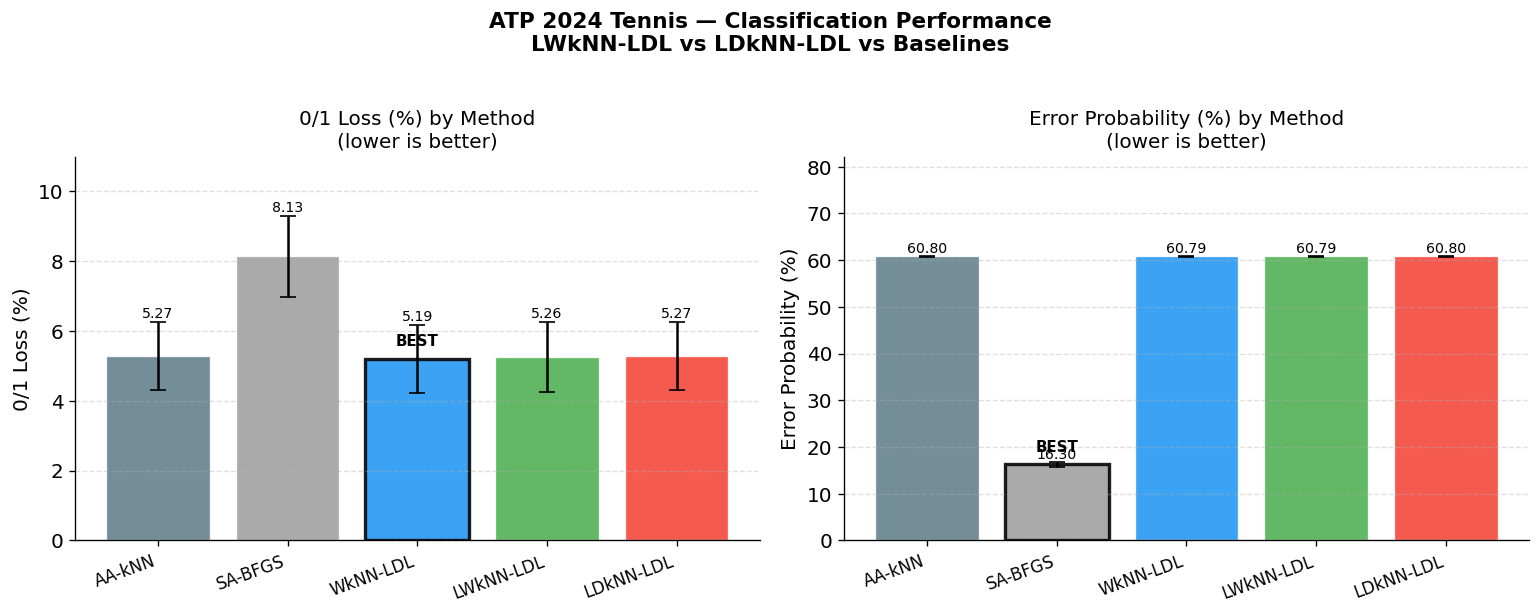
The notebook uses ATP 2024 statistics and six performance features, comparing AA-kNN, SA-BFGS, WkNN-LDL, LWkNN-LDL, and LDkNN-LDL. Its saved outputs compare both classification decisions and the behavior of the predicted distributions.
02 / Engineering perspective
How the project works
Clean match statistics, construct player-level instances, and derive performance features and target label distributions.
Compare neighborhood weighting strategies and distribution-learning baselines across repeated trials.
Inspect classification loss, error probability, distribution similarity, and optimization convergence rather than relying on one metric.
03 / Engineering perspective
Results & Outcomes
Processes 3,016 cleaned matches into 6,032 player instances with six performance features.
WkNN-LDL records 5.19% 0/1 loss in the saved comparison; SA-BFGS performs best on the separately defined error-probability measure at 16.30%.
04 / Engineering perspective
Why this project matters
Preserves uncertainty and mixed performance characteristics that a hard label can conceal.
Illustrates that the best method can differ by evaluation measure; classification loss and distribution quality answer different questions.
Provides interpretable sports-analytics experiments based on familiar match statistics.
05 / Potential next steps
Advancing AI & Future Directions
Research opportunities and proposed extensions, rather than completed achievements.
Test player-disjoint and chronological evaluation splits to better measure performance on unseen athletes and future matches.
Study calibration and alternative target distributions to assess whether the probabilities carry useful uncertainty information.
Extend the approach to other tasks with overlapping labels, such as skill assessment or multi-attribute performance analysis.