Case study / 03
Digital Image Watermarking and Copyright Protection Using Haar Wavelet Transform
Embeds a grayscale watermark inside a cover image using Haar wavelet transforms, then extracts it to verify recovery. A MATLAB application exposes embedding modes, strength controls, image comparisons, and studies of compression, cropping, and resizing.
01 / Context & purpose
The project in detail
Digital watermarking embeds an ownership signal into an image while aiming to preserve its visual quality. This project uses the Haar wavelet transform to work with image coefficients, then recovers the embedded grayscale watermark to check whether the signal survives.
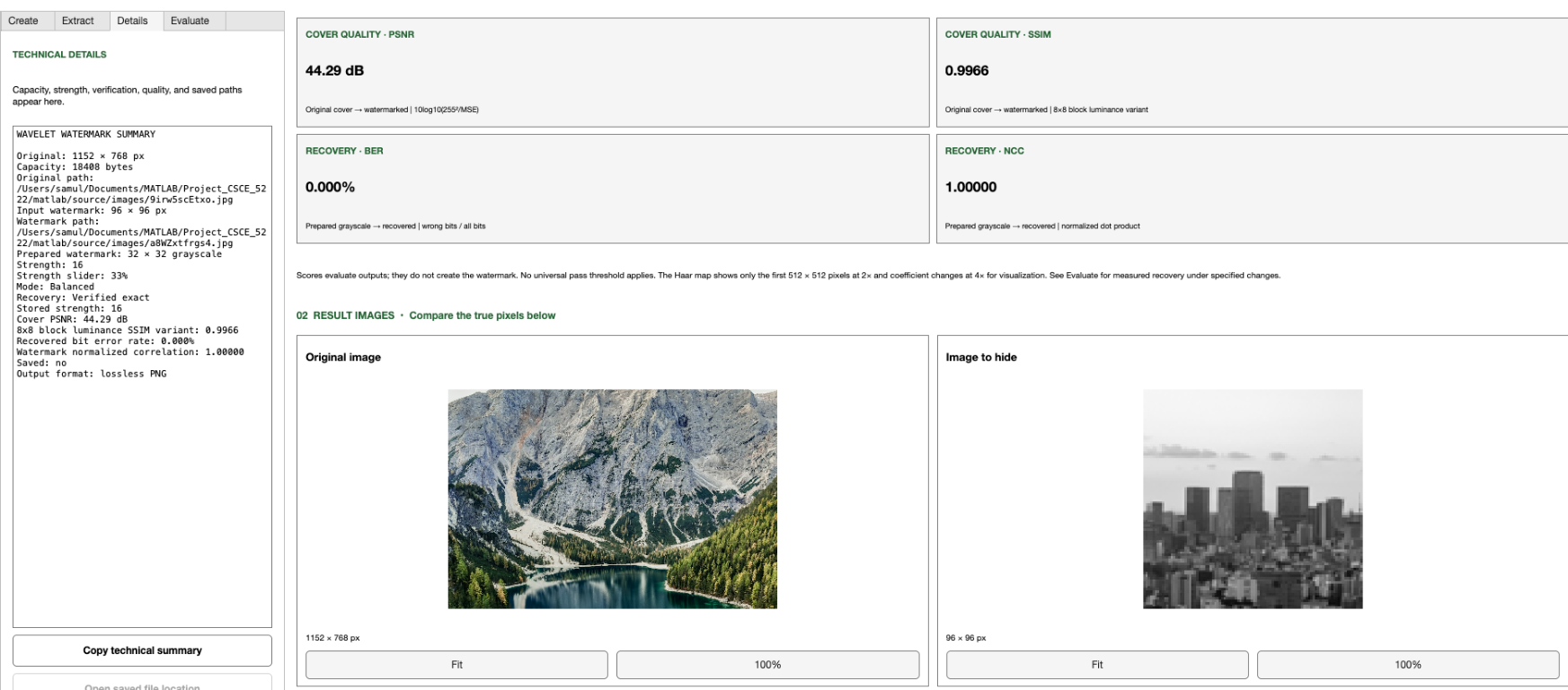
The MATLAB application makes the process inspectable through Create, Extract, Details, and Evaluate views. Its quality and recovery measurements distinguish how closely the watermarked image resembles the original from how accurately the hidden watermark is recovered.
02 / Engineering perspective
How the project works
Choose cover and watermark images, prepare the watermark, and check available embedding capacity.
Select embedding strength and mode, create a watermarked image, and compare extracted content with the prepared watermark.
Measure PSNR and block SSIM for cover quality, BER and NCC for recovery, then study the effects of compression, cropping, and resizing.
03 / Engineering perspective
Results & Outcomes
The captured Balanced-mode example reports 44.29 dB PSNR and 0.9966 block SSIM for cover-image quality.
That unchanged-image example achieves exact recovery: 0.000% bit error rate and normalized correlation of 1.00000; altered-image recovery depends on the operation and settings.
04 / Engineering perspective
Why this project matters
Demonstrates a practical signal-processing approach to ownership marking and image provenance.
Makes the trade-off between imperceptibility, capacity, and recovery robustness measurable.
Provides a visual experimentation environment instead of treating watermark recovery as an unexplained pass/fail result.
05 / Potential next steps
Advancing AI & Future Directions
Research opportunities and proposed extensions, rather than completed achievements.
Compare transform-based watermarking with learned embedding and extraction models under a consistent attack benchmark.
Investigate provenance signals for AI-generated media while keeping ownership marking distinct from proof of authenticity.
Extend robustness studies to additional compression settings, geometric transformations, and adversarial modifications.