Case study / 04
Data Visualization and Travel Recommendation System — TravelWise
Recommends personalized travel plans using destination, accommodation, transport, and activity datasets. The Next.js application combines budget and preference filters with maps and cost visualizations to help users compare trip options.
01 / Context & purpose
The project in detail
Travel planning combines several constraints: where to go, how much to spend, where to stay, and which activities fit the traveler’s interests. TravelWise brings these decisions into a recommendation workflow backed by destination, transport, accommodation, and activity datasets.
The repository implements a Next.js application and server-side recommendation API, alongside a Python CLI with a SQLite indexing workflow. It exposes estimated costs and budget fit, while retaining source rows so recommendations can be traced to the underlying data.
02 / Engineering perspective
How the project works
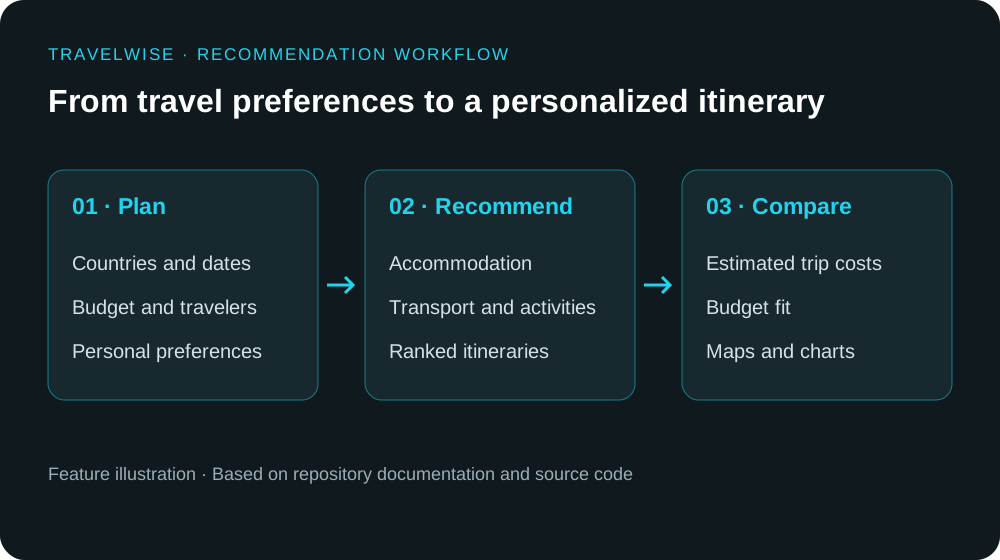
Collect countries, dates, traveler counts, budget settings, and preference filters.
Combine accommodation, transport, and nearby activity candidates into itinerary recommendations.
Expose ranked options with cost visualizations and geographic context so users can compare the trade-offs.
03 / Engineering perspective
Results & Outcomes
Builds ranked itinerary recommendations with estimated trip costs, budget-fit percentages, and nearby activities based on user preferences.
Retains source dataset rows for recommended accommodations, activities, and routes, with a Python CLI and a server-side recommendation API. No measured recommendation-accuracy benchmark is published.
04 / Engineering perspective
Why this project matters
Transforms heterogeneous travel datasets into a coherent decision-support experience.
Makes recommendation reasoning easier to inspect through costs, budget fit, geography, and retained source records.
Connects data engineering, recommendation logic, and interactive visualization in one application.
05 / Potential next steps
Advancing AI & Future Directions
Research opportunities and proposed extensions, rather than completed achievements.
Collect consent-based feedback to evaluate recommendation relevance before introducing learned ranking.
Explore multi-objective ranking that balances budget, preference coverage, travel time, and accessibility.
Evaluate recommendation explanations and data freshness so future AI-assisted planning remains grounded in verifiable options.