Case study / 01
Predictive Maintenance Using Deep Learning — NASA C-MAPSS Remaining Useful Life Prediction
Predicts aircraft-engine remaining useful life from multivariate sensor histories in the NASA C-MAPSS dataset. The project compares MLP, LSTM, and temporal convolutional networks to study degradation patterns and support maintenance planning.
01 / Context & purpose
The project in detail
Maintenance decisions depend on estimating how much useful operation remains before equipment reaches failure. This project treats engine health as a time-series regression problem, using the NASA C-MAPSS simulated turbofan degradation datasets to connect sensor observations with remaining useful life.
The repository contains MLP, LSTM, and TCN implementations, saved models, per-engine predictions, and diagnostic plots. The different architectures provide ways to compare a feed-forward baseline with models that explicitly learn temporal relationships.
02 / Engineering perspective
How the project works
Prepare sensor histories and remaining-life targets, inspecting raw signals and the effects of preprocessing.
Train the neural-network architectures and inspect loss curves to understand optimization behavior.
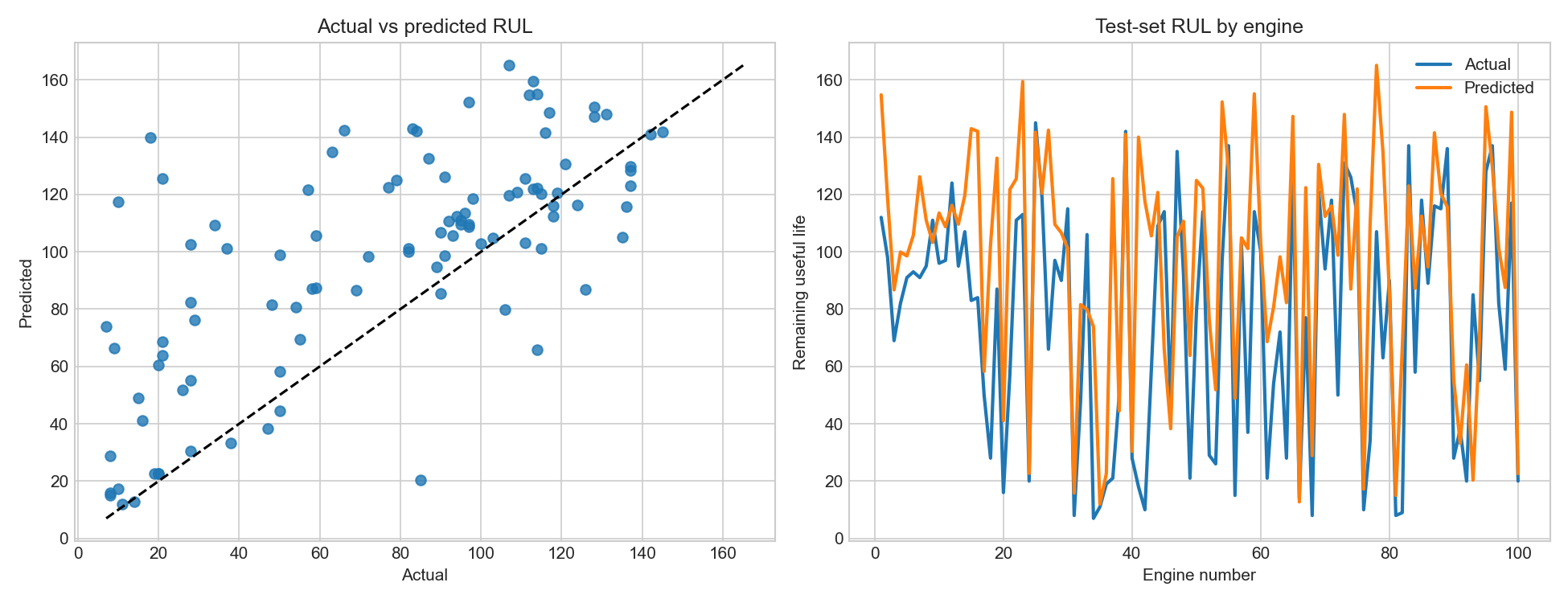
Compare predictions with held-out engine lifetimes using RMSE and MAE, alongside per-engine plots that expose overestimation and underestimation.
03 / Engineering perspective
Results & Outcomes
Saved TCN FD001 evaluation reports test RMSE of 37.96 cycles and MAE of 28.25 cycles.
Exports per-engine predictions, training curves, and evaluation summaries for inspecting model errors.
04 / Engineering perspective
Why this project matters
Shows how sensor data can support condition-based maintenance rather than relying only on fixed service intervals.
Makes prediction errors visible at the engine level, where an overly optimistic lifetime estimate can have different consequences from an early maintenance recommendation.
Creates a reproducible comparison of neural architectures using a public degradation benchmark.
05 / Potential next steps
Advancing AI & Future Directions
Research opportunities and proposed extensions, rather than completed achievements.
Add calibrated uncertainty intervals so maintenance planners can consider confidence as well as a single lifetime estimate.
Evaluate generalization across operating conditions and other C-MAPSS subsets, with explicit separation of engines across training and evaluation.
Explore physics-informed learning and online drift monitoring before considering use with real equipment.