Case study / 07
Automated Essay Grading and Performance Prediction Using Machine Learning | 2025
Explores automated essay scoring using readability, writing errors, lexical diversity, and cohesion features. The notebook compares Lasso and decision-tree regression across school, college, and graduate essay groups, generating predicted scores and diagnostic plots.
01 / Context & purpose
The project in detail
Automated essay scoring studies whether measurable writing features can help estimate assessment outcomes. This notebook combines readability, writing errors, lexical diversity, and cohesion with regression models to investigate score prediction across education groups.
The project compares Lasso and decision-tree predictions for school, college, and graduate essays, exporting diagnostic plots and evaluation summaries. Its negative test R² values in some groups are important limitations: generating scores is not the same as demonstrating dependable assessment quality.
02 / Engineering perspective
How the project works
Extract writing-quality and readability features and organize essay groups by education level.
Train regression models and compare predicted scores with reference scores using held-out evaluation.
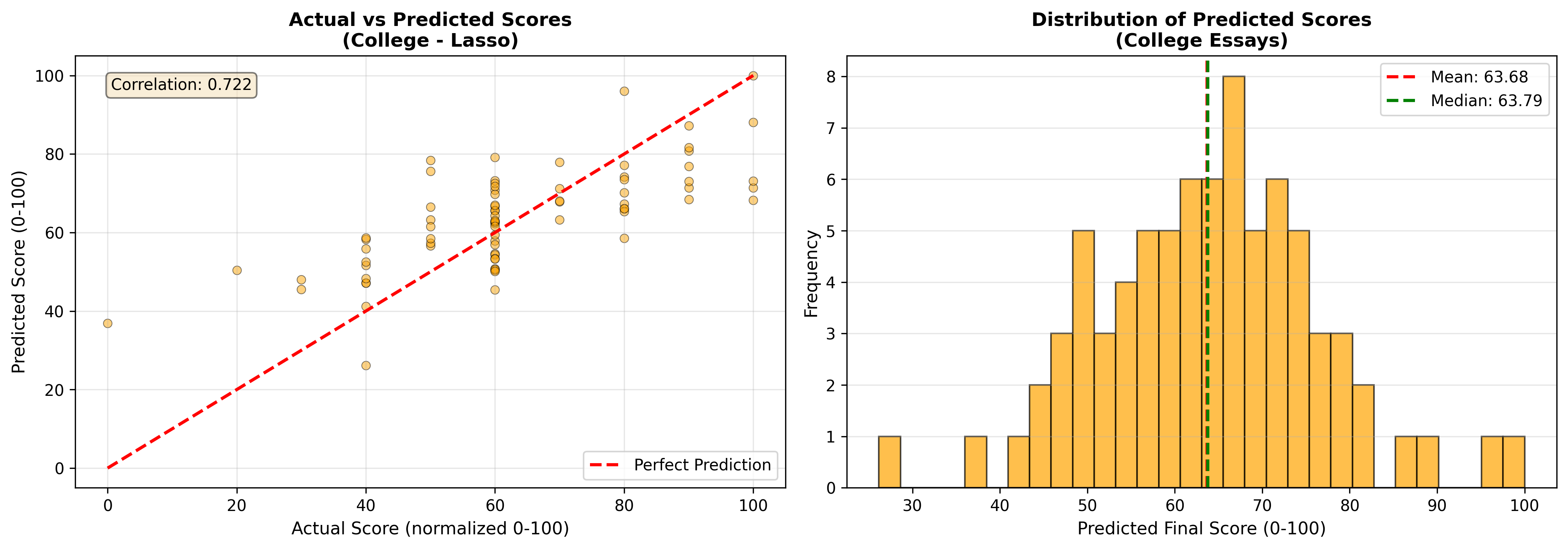
Inspect prediction scatterplots, feature relationships, and group-specific errors to identify where the model needs improvement.
03 / Engineering perspective
Results & Outcomes
Produces score predictions for 1,814 essays: 1,690 school-level, 78 college-level, and 46 graduate-level examples.
Exports actual-versus-predicted score plots and model comparisons. Saved decision-tree test R² values are negative for the college and graduate groups, indicating that further model validation and improvement are needed.
04 / Engineering perspective
Why this project matters
Connects interpretable language features with model behavior instead of producing an unexplained grade.
Shows why evaluation must examine performance separately across different learner groups.
Offers a research foundation for feedback tools that assist educators while leaving assessment decisions under human oversight.
05 / Potential next steps
Advancing AI & Future Directions
Research opportunities and proposed extensions, rather than completed achievements.
Use larger, independently scored datasets and evaluate agreement with human raters across prompts and groups.
Explore contextual language representations while checking whether added complexity improves generalization.
Investigate rubric-aligned feedback, bias audits, and uncertainty estimates before considering consequential grading use.